
Why Christie’s “Azure Blue” Diamond Made Jewelry Headlines
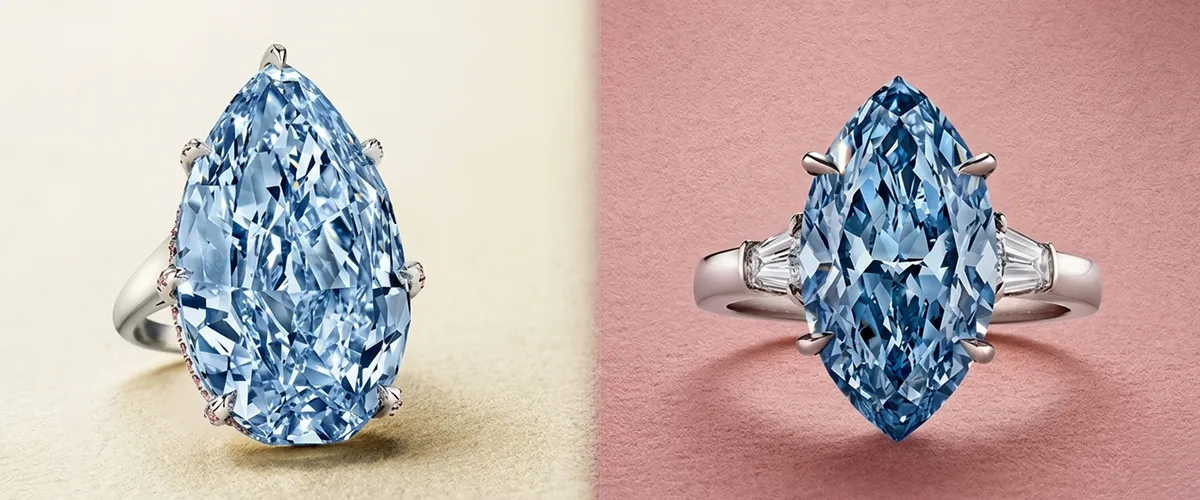
A rare blue diamond just made headlines at Christie’s Magnificent Jewels sale in Rockefeller Center after selling for more than $8.3 million.
Its name is “Azure Blue.”
Its size is 31.62 carats.
That alone is enough to make any jewelry lover stop and look, but the story gets even more interesting. That same evening, a 5.04-carat Fancy Vivid Blue marquise diamond sold for more than $8.1 million, proving once again that color, rarity, and quality can matter just as much as size.
So what makes a blue diamond worth more than a luxury home?
What Makes Blue Diamonds So Rare?
The answer starts deep below the earth.
Diamonds are made of carbon, and pure carbon is naturally colorless. Blue diamonds get their color from tiny traces of boron that become part of the diamond’s crystal structure as it forms underground over millions, and sometimes billions, of years.
That boron changes how the diamond absorbs light. It absorbs red light and allows blue wavelengths to show through, giving the diamond its incredible blue appearance.
Most natural blue diamonds are classified as Type IIb diamonds, one of the rarest diamond categories in the world. In simple terms, no boron means no natural blue color.
Why Color Grade Matters
With white diamonds, less color usually means more value. With fancy colored diamonds, it is the opposite.
The stronger and more saturated the color, the more valuable the diamond can become.
The GIA grades fancy colored diamonds using terms such as:
Faint, Light, Fancy, Fancy Intense, Fancy Vivid, Fancy Dark, and Fancy Deep
This is why a smaller Fancy Vivid Blue diamond can command a price close to, or even higher than, a much larger diamond with a softer color grade. Saturation, rarity, cut, clarity, and overall beauty all play a role.
You Don’t Need $8 Million to Own Color
While “Azure Blue” is the kind of diamond that belongs in auction headlines, colored gemstones and fancy colored diamonds exist in many sizes, qualities, and price points.
From blue diamonds to sapphires, spinels, tourmalines, emeralds, and other rare stones, color gives jewelry personality. The same principles still matter: origin, color saturation, clarity, cut, and how the stone is set.
At D’Errico Jewelry, our in-house team helps clients source colored diamonds and gemstones, then designs custom settings around each stone’s natural character. Instead of placing a special stone into a generic mounting, we build the piece around what makes that stone unique.
Find Your Own Rare Color Story
A headline like this reminds us why rare gemstones continue to capture attention around the world.
Whether you are interested in a colored diamond, a sapphire, or a one-of-a-kind gemstone, D’Errico Jewelry can help you explore options that fit your style and budget.
Stop by D’Errico Jewelry or schedule a private consultation with our design team to start creating a piece built around your own rare color story.
Source: https://nationaljeweler.com/articles/15036-31-62-carat-azure-blue-diamond-sells-for-8m-at-christie-s
A rare blue diamond just made headlines at Christie’s Magnificent Jewels sale in Rockefeller Center after selling for more than $8.3 million.
Its name is “Azure Blue.”
Its size is 31.62 carats.
That alone is enough to make any jewelry lover stop and look, but the story gets even more interesting. That same evening, a 5.04-carat Fancy Vivid Blue marquise diamond sold for more than $8.1 million, proving once again that color, rarity, and quality can matter just as much as size.
So what makes a blue diamond worth more than a luxury home?
What Makes Blue Diamonds So Rare?
The answer starts deep below the earth.
Diamonds are made of carbon, and pure carbon is naturally colorless. Blue diamonds get their color from tiny traces of boron that become part of the diamond’s crystal structure as it forms underground over millions, and sometimes billions, of years.
That boron changes how the diamond absorbs light. It absorbs red light and allows blue wavelengths to show through, giving the diamond its incredible blue appearance.
Most natural blue diamonds are classified as Type IIb diamonds, one of the rarest diamond categories in the world. In simple terms, no boron means no natural blue color.
Why Color Grade Matters
With white diamonds, less color usually means more value. With fancy colored diamonds, it is the opposite.
The stronger and more saturated the color, the more valuable the diamond can become.
The GIA grades fancy colored diamonds using terms such as:
Faint, Light, Fancy, Fancy Intense, Fancy Vivid, Fancy Dark, and Fancy Deep
This is why a smaller Fancy Vivid Blue diamond can command a price close to, or even higher than, a much larger diamond with a softer color grade. Saturation, rarity, cut, clarity, and overall beauty all play a role.
You Don’t Need $8 Million to Own Color
While “Azure Blue” is the kind of diamond that belongs in auction headlines, colored gemstones and fancy colored diamonds exist in many sizes, qualities, and price points.
From blue diamonds to sapphires, spinels, tourmalines, emeralds, and other rare stones, color gives jewelry personality. The same principles still matter: origin, color saturation, clarity, cut, and how the stone is set.
At D’Errico Jewelry, our in-house team helps clients source colored diamonds and gemstones, then designs custom settings around each stone’s natural character. Instead of placing a special stone into a generic mounting, we build the piece around what makes that stone unique.
Find Your Own Rare Color Story
A headline like this reminds us why rare gemstones continue to capture attention around the world.
Whether you are interested in a colored diamond, a sapphire, or a one-of-a-kind gemstone, D’Errico Jewelry can help you explore options that fit your style and budget.
Stop by D’Errico Jewelry or schedule a private consultation with our design team to start creating a piece built around your own rare color story.
Source: https://nationaljeweler.com/articles/15036-31-62-carat-azure-blue-diamond-sells-for-8m-at-christie-s